
What is Sophrology?
LGS Solutions often proposes Sophrology techniques when crafting custom solutions to people struggles.

Sophrology pioneers
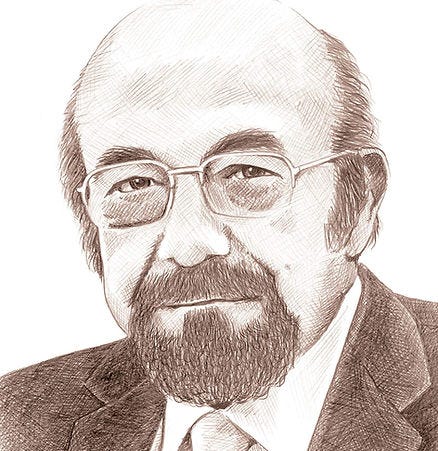
Alfonso Caycedo
Alfonso Caycedo (1932–2017) was a neuropsychiatrist from Colombia and the founder of Sophrology, a mind–body discipline that blends Western psychology and neuroscience with Eastern contemplative traditions like yoga and meditation.
Biography
Full name: Alfonso Caycedo (often referred to as Prof. Alfonso Caycedo).
Born: 1932 in Bogotá, Colombia.
Died: 2017 in Spain.
Profession: Neuropsychiatrist, professor, and researcher in consciousness and relaxation methods.
After studying medicine and psychiatry, Caycedo began working with patients suffering from trauma, depression, and anxiety in the 1950s. He observed that traditional psychiatric treatments of the time — including electroshock and heavy medication — were often dehumanizing and failed to address the patient’s inner experience.
This led him to seek gentler, consciousness-based approaches to healing.
The Birth of Sophrology
In 1960, while working as a psychiatrist in Madrid, he founded Sophrology, from the Greek words:
Sôs (harmony),
Phren (consciousness),
Logos (study).
So Sophrology literally means “the study of consciousness in harmony.”
Caycedo then traveled extensively through India, Tibet, and Japan, where he studied Yoga, Zen, and Tibetan Buddhism. These traditions inspired him to integrate breathing, visualization, body awareness, and mental focus into clinical practice — marking the beginning of the first Sophrology techniques.
Core Philosophy
Caycedo believed that the human consciousness could be trained and harmonized, just like the body, and that well-being arises when we live in alignment with our values, sensations, and presence in the moment.
His work focused on:
Relaxation and awareness of the body,
Mental clarity and emotional regulation,
Positive action and self-development,
Activation of inner resources (what he called the “phenomenological experience” of being).
Legacy & Influence
Today, Sophrology is widely used across Europe, especially in France, Switzerland, and Belgium, in fields like:
Stress management and burnout prevention
Pain and sleep disorder management
Sports performance and stage preparation
Personal development and trauma recovery
Caycedo’s holistic vision has inspired many integrative approaches, including YogaSophro, which naturally bridges Eastern practices (like Yoga Nidra or Raja Yoga) with Caycedian Sophrology’s structured consciousness work.
The Isocay® method
“Isocay” is a specific method developed by Dr. Alfonso Caycedo, the founder of sophrology, as an advanced technique within the sophrology framework. The name “Isocay” is derived from “Iso” (meaning equilibrium or harmony in Greek) and “Cay” (from Caycedo), symbolizing Caycedo’s unique approach to achieving inner balance and consciousness.
The Isocay method is designed to deepen self-awareness, harmonize the body and mind, and facilitate access to higher states of consciousness. It integrates sophrology’s fundamental principles with specific breathing techniques, postures, and mental exercises to create a structured yet flexible practice.
The method is often described as a “dynamic relaxation” technique, combining:
Conscious breathing (sophronization)
Gentle movements (dynamic relaxation)
Mental imagery (vivance)
Existential reflection
It is particularly useful for:
Stress management
Emotional regulation
Enhancing creativity and intuition
Preparing for meditation or spiritual practices
Improving focus and presence
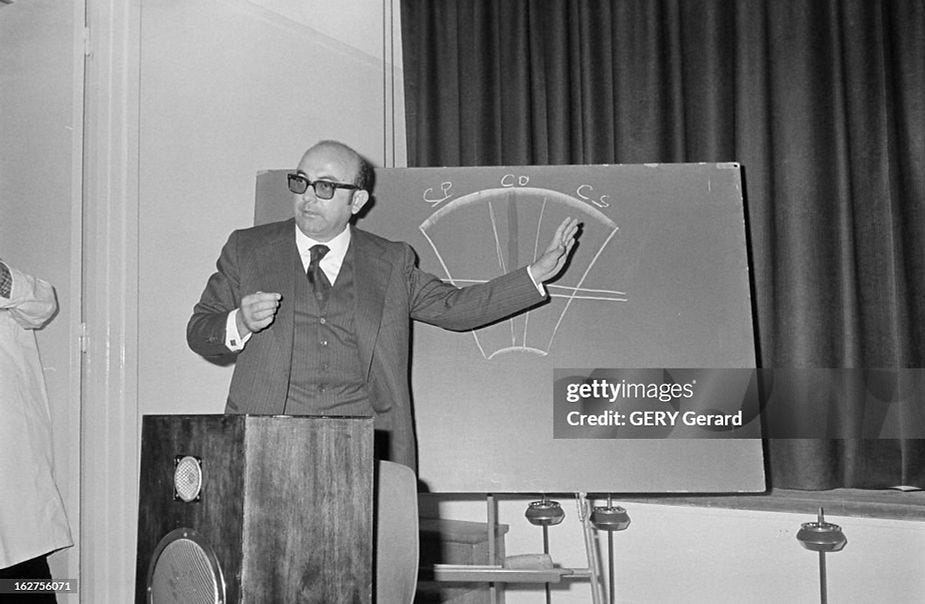
The Isocay method is built on three pillars:
1. The Three States of Consciousness
The method works with three fundamental states of consciousness, as defined by Caycedo:
Ordinary State of Consciousness (État Ordinaire de Conscience, EOC)
The everyday, waking state where the mind is active, often scattered, and influenced by external stimuli.
Goal: To recognize this state and transition toward deeper awareness.
Phronic State of Consciousness (État Phronique de Conscience, EPC)
A state of heightened awareness achieved through sophrology exercises.
Characterized by clarity, presence, and connection between body and mind.
Goal: To cultivate this state through practice.
Sophro-Liminal State of Consciousness (État Sophro-Liminaire de Conscience, ESLC)
A transitional state between wakefulness and sleep, where the mind is highly receptive to positive suggestions and imagery.
Often described as a “doorway” to deeper consciousness or creative insights.
Goal: To access this state intentionally for healing, learning, or transformation.
2. The Three Fundamental Exercises
The Isocay method includes three core exercises, each designed to shift consciousness and integrate body, mind, and spirit:
A. Sophronization of the Phrenic System (Sophronisation du Système Phrénique, SSP)
Objective: To activate the phrenic nerve (which connects the brain to the diaphragm) and stimulate diaphragmatic breathing for relaxation and energy.
Technique:
The practitioner places their hands on the diaphragm (around the solar plexus) and guides the person to breathe deeply into this area.
The breath is slow, conscious, and rhythmic, creating a wave-like movement in the abdomen.
Mental focus: Directing attention to the sensation of the breath and the expansion of the diaphragm.
Purpose:
To ground the individual in the present moment.
To release tension in the diaphragm and improve oxygen flow.
To prepare the body and mind for deeper sophrology exercises.
B. Vivance of the Phrenic System (Vivance du Système Phrénique, VSP)
Objective: To intensify the connection between the breath, body, and consciousness.
Technique:
Combines diaphragmatic breathing with mental imagery (e.g., visualizing the breath as a golden light filling the body).
The person is guided to feel the vitality of the breath and its transformative power.
Often includes affirmations (e.g., “My breath connects me to my inner strength”).
Purpose:
To awaken the body’s energy and enhance vitality.
To deeply integrate the breath into one’s daily life as a tool for calm and focus.
C. Sophro Acceptance Progressive (SAP) or Sophro Substitution (SS)
Objective: To replace negative thoughts, emotions, or sensations with positive alternatives.
Techniques:
Sophro Acceptance Progressive (SAP): Gradually accepting and integrating a positive thought or emotion (e.g., “I accept my fear and transform it into courage”).
Sophro Substitution (SS): Swapping a negative state (e.g., anxiety) for a positive one (e.g., calm) through mental imagery and affirmation.
Purpose:
To rewire the mind for resilience and optimism.
To create new neural pathways that support well-being and growth.
3. The Three Levels of Practice
The Isocay method is structured into three levels, each building upon the previous one:
A. Level 1: Relaxation and Awareness
Focuses on basic relaxation techniques, breath awareness, and body scanning.
Exercises include SSP (Sophronization of the Phrenic System) and simple vivances.
Goal: To reduce stress and develop mindfulness.
B. Level 2: Activation and Integration
Introduces more dynamic exercises, such as movement-based relaxation and emotional exploration.
Techniques include VSP (Vivance of the Phrenic System) and Sophro Acceptance Progressive (SAP).
Goal: To activate inner resources and integrate body and mind.
C. Level 3: Transformation and Consciousness
Explores advanced practices like Sophro-Liminal exercises, existential reflection, and manifestation techniques.
Includes Sophro Substitution (SS) and work with the three states of consciousness.
Goal: To transform limiting patterns, access deeper states of awareness, and align with one’s true purpose.
How Isocay Differs from Traditional Sophrology
While Isocay is rooted in sophrology, it is more structured and systematic, with a stronger emphasis on the phrenic system and consciousness states. Key differences include:
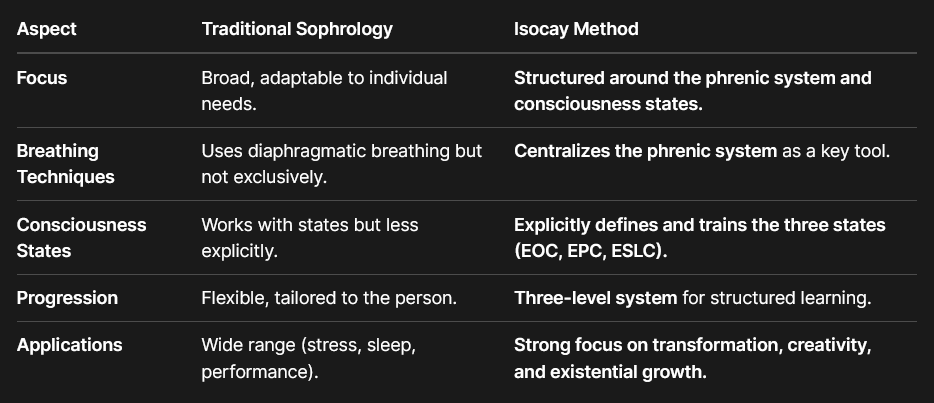
The Isocay method is designed to enhance well-being
On multiple levels:
Physical:
Improves breathing patterns and oxygenation.
Reduces muscle tension and fatigue.
Boosts energy levels and vitality.
Mental:
Calms anxiety and mental chatter.
Enhances focus, clarity, and creativity.
Supports emotional regulation and resilience.
Emotional:
Helps release repressed emotions.
Encourages self-acceptance and compassion.
Fosters positive thinking and optimism.
Existential:
Deepens self-awareness and presence.
Facilitates access to higher states of consciousness.
Supports personal growth and alignment with purpose.
Who Can Benefit from Isocay?
The Isocay method is suitable for:
Beginners in sophrology who want a structured introduction.
Experienced practitioners looking to deepen their practice.
Individuals seeking stress relief, emotional healing, or personal transformation.
Professionals (e.g., therapists, coaches, artists) who want to enhance creativity and focus.
Anyone interested in exploring consciousness and existential growth.
Practical Example: A Simple Isocay Exercise
Here’s a basic Isocay exercise you can try:
Exercise: Sophronization of the Phrenic System (SSP)
Posture: Sit or lie down comfortably. Place your hands on your diaphragm (solar plexus area).
Breathing: Inhale deeply through your nose, filling your abdomen (not your chest). Feel your hands rise and fall with each breath.
Focus: Imagine your breath is a warm, golden light flowing into your body with each inhale. On the exhale, visualize releasing tension or stress.
Affirmation: Silently repeat, “I am calm. My breath connects me to my inner strength.”
Duration: Practice for 5–10 minutes, gradually increasing to 20 minutes.
The Isocay method is a powerful tool for anyone seeking to deepen their self-awareness, transform their consciousness, and live a more balanced and purposeful life. By integrating breath, movement, mental imagery, and existential reflection, it offers a holistic path to well-being and growth.
If you’re new to sophrology, starting with Isocay can provide a clear and structured foundation. For those already familiar with sophrology, it can elevate your practice to new levels of transformation and insight.
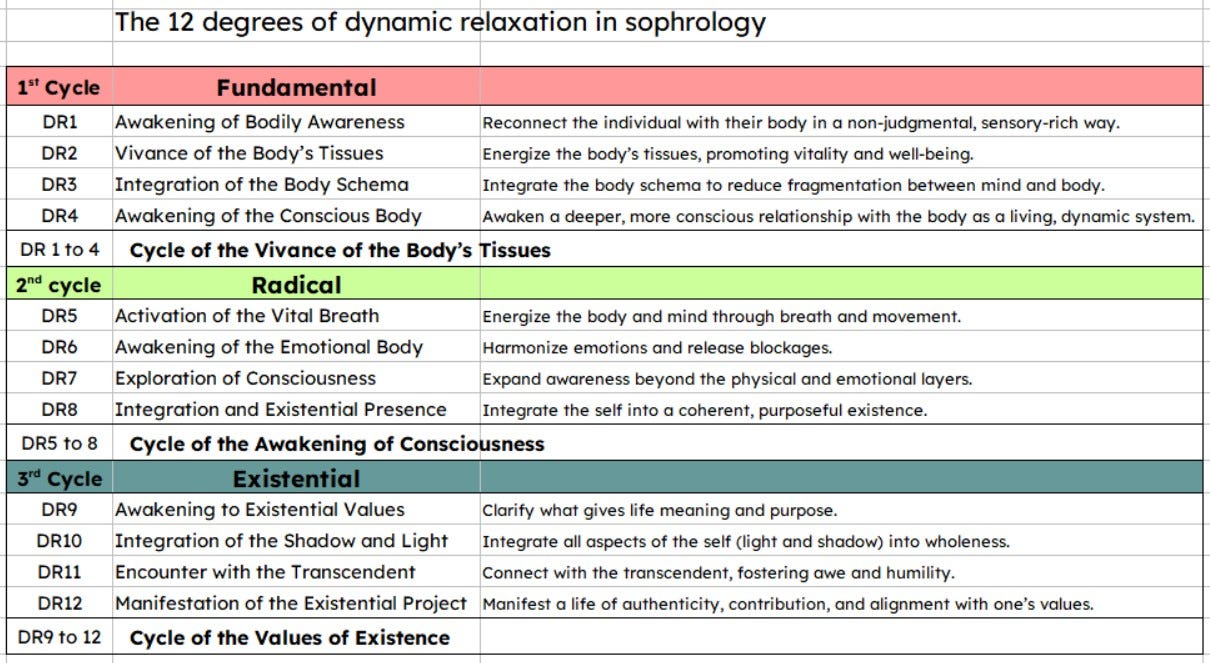
The 12 Degrees of Sophrology
Sophrology’s 12 degrees of Relaxation Dynamique (RD) are structured into three cycles, each designed to meet you where you are and guide you toward deeper self-awareness, resilience, and harmony. The First Cycle (degrees 1–4) focuses on awakening bodily awareness and grounding techniques—ideal for those reconnecting with themselves after trauma, burnout, or neurodivergent challenges. These practices are foundational, gentle, and accessible, helping you rebuild trust in your body and mind. The Second Cycle (degrees 5–8) dives into emotional regulation, mental clarity, and projective techniques, empowering you to reframe limiting beliefs and cultivate a more balanced perspective. Finally, the Third Cycle (degrees 9–12) explores existential values, purpose, and consciousness expansion, offering tools for those seeking deeper meaning or preparing for life transitions.
At LGS Solutions, I prioritize the First Cycle in my content because its practices are universally accessible and particularly impactful for autistic individuals and trauma survivors—helping them gradually reclaim agency over their bodies and minds. However, my work extends across all three cycles, with somatic-based protocols tailored to each stage. Whether you’re here to ground yourself, reframe your mindset, or explore existential questions, I meet you with practical, science-aligned methods—no gurus, no dogma, and no pressure to conform to any ideology. My role is to guide you safely, respecting your values and pace, so you can integrate Sophrology in a way that feels authentic to you.
How to Choose your Sophrologist
A skilled guide will adapt to your needs, not the other way around.
Look for someone who:
✔ Listens more than they prescribe—your objectives shape the journey.
✔ Works within your comfort zone (e.g., somatic approaches for trauma, projective techniques for anxiety).
✔ Avoids one-size-fits-all solutions—Sophrology is a toolkit, not a rigid system.
✔ Respects your boundaries—no forcing, no spiritual bypassing, and no pressure to “achieve enlightenment.”
If you’re curious about where to start, I’m here to help you navigate the cycles with clarity and care. The right guide won’t just teach you techniques—they’ll partner with you to unlock what’s already within.
1. The Cycle of the Vivance of the Body’s Tissues
Sophrology’s first fundamental cycle of dynamic relaxation is called the “Cycle of the Vivance of the Body’s Tissues” (Cycle de la Vivance des Tissus du Corps). This cycle focuses on awakening bodily awareness, integrating physical sensations, and establishing a deep connection between the body and consciousness. It consists of four degrees, each building upon the previous one to foster relaxation, presence, and harmony.
Here’s a global description of the four degrees in this cycle:
1. First Degree: Awakening of Bodily Awareness
Objective: To ground the individual in the present moment by focusing on bodily sensations.
Key Focus:
Perception of the body as a whole: Encouraging the person to observe their body without judgment, noticing areas of tension, relaxation, or neutrality.
Sensory exploration: Directing attention to physical sensations (e.g., contact with the ground, temperature, weight, or texture).
Neutral observation: Teaching the individual to observe their body objectively, without trying to change anything.
Techniques:Body scan: Mentally traversing the body from head to toe.
Breath awareness: Using the breath as an anchor to deepen presence.
Goal: To develop a non-reactive awareness of the body’s current state.
2. Second Degree: Vivance of the Body’s Tissues
Objective: To intensify the connection with the body’s tissues (muscles, organs, bones) and awaken their “vitality.”
Key Focus:
Sensorial amplification: Encouraging the person to feel the aliveness of their tissues, not just their structure.
Energy flow: Guiding the individual to perceive subtle energy or warmth within the tissues.
Dissolution of boundaries: Helping the person experience the body as a unified, interconnected system.
Techniques:Tissue awakening: Directing attention to specific areas (e.g., “Feel the vitality in your hands” or “Notice the warmth in your abdomen”).
Micro-movements: Gentle, imperceptible movements to stimulate tissue awareness.
Goal: To experience the body as a dynamic, living entity rather than a static structure.
3. Third Degree: Integration of the Body Schema
Objective: To consolidate the body schema (mental representation of the body) and align it with physical reality.
Key Focus:
Harmonization of perception: Ensuring the person’s internal body schema matches their actual physical state.
Postural awareness: Noticing alignment, balance, and symmetry.
Embodiment: Strengthening the connection between the body and mind.
Techniques:Postural adjustments: Encouraging small, mindful movements to realign the body.
Visualization: Guiding the person to mentally “reconstruct” their body schema.
Goal: To achieve a coherent and integrated experience of the body, reducing dissociation or disconnection.
4. Fourth Degree: Awakening of the Conscious Body
Objective: To transcend physical awareness and awaken a unified consciousness of the body and mind.
Key Focus:
Non-dual awareness: Experiencing the body as an extension of consciousness.
Existential presence: Feeling the body as a vehicle for life and vitality.
Transcendence of limits: Moving beyond the ego’s identification with the physical form.
Techniques:Silent presence: Encouraging the person to simply “be” with their body without analysis.
Affirmations: Using positive, empowering statements (e.g., “My body is alive and vibrant”).
Goal: To experience the body as a sacred, conscious entity—a bridge between the physical and spiritual.
Global Purpose of the Cycle
The Cycle of the Vivance of the Body’s Tissues aims to:
Reconnect the individual with their body in a non-judgmental, sensory-rich way.
Energize the body’s tissues, promoting vitality and well-being.
Integrate the body schema to reduce fragmentation between mind and body.
Awaken a deeper, more conscious relationship with the body as a living, dynamic system.
This cycle is foundational in sophrology, as it lays the groundwork for subsequent cycles that explore emotions, values, and existential themes. It is particularly useful for individuals dealing with stress, dissociation, or a disconnection from their physical selves.
2. The Cycle of the Awakening of Consciousness
The second radical cycle of dynamic relaxation in sophrology is called the “Cycle of the Awakening of Consciousness” (Cycle de l’Éveil de la Conscience). This cycle builds upon the first cycle by deepening the connection between body, mind, and consciousness, moving toward existential awareness and personal transformation.
The four degrees of this cycle focus on activating inner resources, exploring consciousness, and integrating the self in a more profound way. Below is a global description of these four degrees:
1. First Degree: Activation of the Vital Breath
Objective: To stimulate the vital energy (prana or qi) through conscious breathing and movement.
Key Focus:
Conscious breathing: Using the breath to energize the body and mind.
Expansion of vital energy: Directing the breath to specific areas of the body to awaken dormant energy.
Rhythmic harmony: Synchronizing breath with subtle movements to create a flow of vitality.
Techniques:Full yogic breathing: Deep, diaphragmatic breathing to oxygenate the body.
Breath visualization: Imagining the breath as a wave of energy flowing through the body.
Goal: To awaken the body’s vital forces and prepare for deeper consciousness work.
2. Second Degree: Awakening of the Emotional Body
Objective: To explore and integrate emotional energy in a safe and structured way.
Key Focus:
Emotional awareness: Encouraging the person to acknowledge and observe their emotions without judgment.
Release and transformation: Using breath and movement to dissolve emotional blockages.
Integration of opposites: Balancing conflicting emotions (e.g., joy/sadness, fear/courage).
Techniques:Emotional body scan: Mentally scanning for areas of emotional tension.
Affirmations: Using positive statements to reframe emotional patterns.
Goal: To harmonize the emotional body and cultivate emotional resilience.
3. Third Degree: Exploration of Consciousness
Objective: To expand awareness beyond the physical and emotional and explore the depths of consciousness.
Key Focus:
Detachment from thoughts: Observing the mind without getting caught in its narratives.
Silent presence: Cultivating a state of pure awareness beyond mental chatter.
Connection to the universal: Feeling a sense of unity with all existence.
Techniques:Meditation-like states: Encouraging stillness and inner silence.
Guided visualization: Exploring inner landscapes or symbolic imagery.
Goal: To experience consciousness as a boundless, interconnected field.
4. Fourth Degree: Integration and Existential Presence
Objective: To consolidate the insights gained in the previous degrees and embody a new sense of self.
Key Focus:
Wholeness: Feeling a sense of completeness and alignment with one’s true nature.
Purpose and meaning: Reflecting on one’s place in the world and life mission.
Transcendence: Moving beyond the ego to experience existential freedom.
Techniques:Reflective dialogue: Journaling or silent contemplation to integrate experiences.
Affirmations of being: Statements like “I am whole” or “I am connected to all life.”
Goal: To live with greater authenticity, purpose, and inner peace.
Global Purpose of the Cycle
The Cycle of the Awakening of Consciousness aims to:
Energize the body and mind through breath and movement.
Harmonize emotions and release blockages.
Expand awareness beyond the physical and emotional layers.
Integrate the self into a coherent, purposeful existence.
This cycle is particularly powerful for individuals seeking personal growth, spiritual exploration, or healing from emotional wounds. It serves as a bridge between sophrology’s somatic techniques and deeper existential work, making it a cornerstone for those on a path of conscious evolution.
3. The Cycle of the Values of Existence
The third existential cycle of dynamic relaxation in sophrology is called the “Cycle of the Values of Existence” (Cycle des Valeurs d’Existence). This cycle represents the deepest and most transformative phase of sophrology, focusing on existential meaning, personal values, and the alignment of one’s life with higher purpose. It builds upon the previous cycles by integrating consciousness, emotions, and vitality into a coherent and purposeful existence.
The four degrees of this cycle guide the individual toward self-realization, authenticity, and a deeper connection to life’s fundamental values. Below is a global description of these four degrees:
1. First Degree: Awakening to Existential Values
Objective: To identify and connect with the core values that give life meaning.
Key Focus:
Clarification of values: Exploring what truly matters (e.g., freedom, love, creativity, justice, truth).
Alignment with inner truth: Recognizing misalignments between personal values and external expectations.
Sense of purpose: Feeling a deeper calling or mission in life.
Techniques:Value mapping: Exercises to list and prioritize personal values.
Guided introspection: Questions like “What makes my life feel meaningful?”
Symbolic imagery: Visualizing a “tree of values” or “life compass.”
Goal: To awaken a sense of direction and commitment to one’s true values.
2. Second Degree: Integration of the Shadow and Light
Objective: To confront and integrate the shadow self (unconscious fears, wounds, or repressed aspects) and embrace the light (qualities like courage, love, and wisdom).
Key Focus:
Acknowledging the shadow: Recognizing and accepting hidden or disowned parts of the self.
Transforming limitations: Reframing weaknesses into strengths (e.g., vulnerability into empathy).
Wholeness: Moving toward self-acceptance and integrity.
Techniques:Dialogue with the shadow: Imagining a conversation with one’s shadow self.
Affirmations of integration: Statements like “I embrace all parts of myself.”
Creative expression: Art, writing, or movement to externalize inner conflicts.
Goal: To achieve inner harmony and transcend self-judgment.
3. Third Degree: Encounter with the Transcendent
Objective: To experience a connection with something greater than oneself—whether it’s the universe, a higher power, nature, or the collective unconscious.
Key Focus:
Mystical or peak experiences: Moments of awe, wonder, or unity with existence.
Surrender and trust: Letting go of control and embracing faith in a larger order.
Sacredness of life: Recognizing the divine or sacred in everyday moments.
Techniques:Nature immersion: Exercises to connect with the natural world.
Meditation on infinity: Visualizing boundless space or time.
Rituals of gratitude: Practices to honor life’s mysteries.
Goal: To cultivate a sense of awe, humility, and connection to the transcendent.
4. Fourth Degree: Manifestation of the Existential Project
Objective: To translate insights and values into action, creating a lived existential project that aligns with one’s true self.
Key Focus:
Personal manifesto: Crafting a statement of purpose or set of guiding principles.
Commitment to action: Taking concrete steps toward a meaningful life.
Legacy and contribution: Reflecting on how one’s existence serves others or the world.
Techniques:Vision boarding: Creating a visual representation of one’s life goals.
Accountability practices: Sharing intentions with a trusted person or group.
Rituals of renewal: Regular check-ins to realign with one’s values.
Goal: To live authentically and contribute to the world in a way that feels aligned with one’s deepest self.
Global Purpose of the Cycle
The Cycle of the Values of Existence aims to:
Clarify what gives life meaning and purpose.
Integrate all aspects of the self (light and shadow) into wholeness.
Connect with the transcendent, fostering awe and humility.
Manifest a life of authenticity, contribution, and alignment with one’s values.
This cycle is profoundly transformative and is often used for:
Existential crises or questions about life’s purpose.
Spiritual growth and the search for meaning.
Personal reinvention or major life transitions.
Preparing for death or end-of-life reflection (as sophrology is also used in palliative care).
It is the pinnacle of the sophrology journey, offering a path to self-realization, wisdom, and a life lived in full consciousness.
What is your current need ? What does your heart desire? What is your soul’s bidding?
Let’s bring clarity into it and work together on realizing your goals.
Schedule your call at https://www.lgs-solutions.com today to get started on your healing journey.
