


If you are a woman who has spent years being misunderstood—by doctors, teachers, employers, or even therapists—this article is especially for you. Maybe you live with ADHD, autism, complex trauma, or a long history of masking and adapting to environments that were never designed with you in mind. Maybe you have tried to ask for help before and were told you were “too sensitive,” “too complicated,” or “not the right kind of patient.”
I want you to know, from the start, that you are not the problem. The systems you met were simply not built for your reality. My work exists in that gap. As you read, you are invited to notice what resonates, what feels safer, and what gives you a sense of “finally, someone is speaking my language.” You don’t have to agree with everything. Just stay in contact with your own sense of truth as we walk through these distinctions together.

I’m Not a Threat—I’m a Partner
If you’ve ever felt confused about what I do—or, worse, tempted to dismiss it as “not real therapy”—this post is for you. Whether you’re a future client trying to understand if my work is right for you, or a therapist wondering how I fit into the bigger picture, I want to address your questions directly, without drama and without defensiveness. My intention is simple: I am not here to compete with therapy, replace your therapist, or undermine anyone’s license. I am here to offer complementary support where many conventional systems are too narrow, too rushed, or simply not designed for the complexity of real lives.
Over the years, I’ve seen how powerful it can be when coaching, brief‑therapies, and traditional therapy coexist instead of fighting for territory. My work often lives in the spaces in‑between: the long weeks between therapy sessions, the practical questions that don’t fit into a diagnostic framework, the daily self‑regulation that most appointments don’t have time to teach in detail. I work alongside, not against. If you are already followed by a psychiatrist, psychologist, or other practitioner, our collaboration can strengthen—not threaten—the care you’re already receiving.
Why This Post Exists
I’m writing this because confusion and skepticism show up around my work again and again. Some people have never experienced coaching and genuinely don’t see the point. From their perspective, if they are not “sick enough” for therapy, they should handle everything alone; and if they are in therapy, anything else looks suspicious or unnecessary. Others only meet coaching through caricatures—satirical selfie videos that mock coaches as scammers, or “mindset gurus” whose main expertise seems to be marketing themselves. It’s understandable that, after enough of this, the word “coach” starts to sound like a red flag instead of a resource.
I also see another, more painful layer. There are people who call themselves coaches but clearly prioritize visibility, branding, and conversion over client safety and fulfillment. They post polished quotes about healing while ignoring basic ethics, boundaries, or trauma‑informed principles. I do not recognize myself in that world, and I do not want to be mistaken for it. At the same time, I sometimes face hostility from psychiatrists, psychologists, or psychotherapists who quickly label me as “unlawful competition” rather than a complementary practitioner. In their eyes, anything that is not strictly inside their professional category becomes a threat.
This post is my way of stepping out of those projections. I want to make my mission and intentions explicit, so you don’t have to guess. I want to be seen and heard from where I actually stand, not from the place where your fears, past disappointments, or worries about the industry live. You have every right to be cautious. My invitation is: let’s be precise about what you are cautious of, and let me show you clearly how I work, so you can make an informed decision.

What I Do (And What I Don’t)
Because I am a polymath and a multi‑discipline practitioner, my work covers several domains—but they all serve the same purpose: helping you move from chaos to clarity, from survival mode to a more grounded, self‑directed life.
On the most concrete level, I offer consulting and information technology support. This can include designing or improving processes, setting up automation, managing data migrations, refining customer service flows, or supporting managers and leaders who need both structure and human understanding. When I put on my consultant hat, we are working on systems: your business systems, your workflow, your communication patterns in a team.
I also provide mentoring and conflict‑resolution support. In that frame, we focus on relationships, communication, and the invisible dynamics that make collaboration either smooth or exhausting. This is particularly helpful for neurodivergent people, highly sensitive profiles, or those who often feel misunderstood in professional environments. Together, we look at how you can protect your energy, communicate more clearly, and navigate difficult situations without abandoning yourself.
Beyond that, I offer personal coaching for emotions management, self‑mastery, and mental preparation. This is where we work on your goals, habits, mindset, and daily strategies. We explore how you respond to stress, how you talk to yourself, how you organize your time and attention, and how you can build a life that aligns with your values instead of just reacting to circumstances.
Finally, I facilitate brief‑therapies and healing protocols that draw from sophrology, Yogasophro, NLP, hypnotherapy, EFT, and relaxology. These sessions are designed to support nervous system regulation, emotional healing, and trauma‑informed change over a series of planned sessions. They are not a substitute for medical or psychiatric treatment, but they can be deeply supportive when you feel overwhelmed, stuck, or exhausted by traditional paths that don’t fully see you.
What I don’t do is promise miracle cures, pretend to be a licensed psychotherapist when I am not, or encourage you to stop necessary medical or psychiatric care. I don’t offer one‑size‑fits‑all protocols. I don’t treat you as a “case” to be fixed, but as a whole person whose story, context, and autonomy matter.

The Therapy-Coaching Spectrum
When you are looking for support, it can be hard to know where to turn. Therapy, coaching, brief‑therapies, mentoring, consulting—all these words float around, often without clear definitions. Many people hesitate for months or years because they are afraid of “choosing wrong.” My intention here is not to create more confusion, but to offer a simple way of seeing the landscape so you can better understand where my work sits and how it can complement therapy, not replace it.
Instead of imagining a strict border between “therapy” and “coaching,” I invite you to picture a spectrum. On one side, you have clinical and highly regulated mental health care. On the other, you have practical, action‑oriented support focused on goals, strategies, and everyday functioning. Most people’s needs move back and forth along this spectrum over time. You might need deep emotional processing one season, and concrete structure and accountability the next. You are not meant to fit into one box forever.
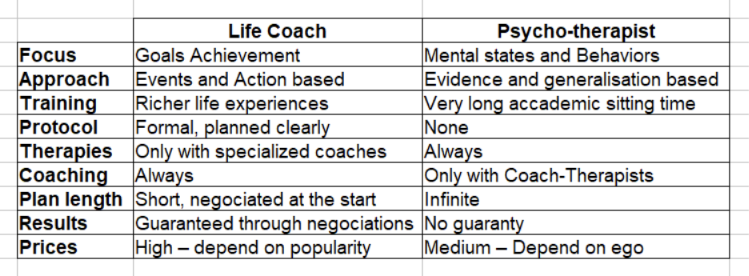
Life Coaching: A Partner in Clarity and Action
A life coach is primarily here to help you move from where you are now to where you want to be next. The focus is on your goals, your values, and your concrete reality: your schedule, your habits, your projects, your choices. Together, you identify what matters most to you, what gets in the way, and which small, doable steps will move you in the right direction.
Coaching is generally future‑oriented and solution‑focused. We do talk about your history—especially when it shapes your patterns—but the main question is: “Given everything you’ve lived, what do you want to create now, and how can we support your nervous system so that change feels possible?” In this space, I am not diagnosing you. I am not placing you inside a clinical category. I am walking beside you, offering structure, feedback, and accountability, so you don’t have to navigate this alone.
Coaches come from diverse backgrounds. Some have formal training in coaching schools, others have a basis in psychology, business, education, somatic practices, or lived experience. In my case, my work is informed by years of consulting, sophrology, NLP, self‑compassion work, and somatic brief‑therapies. I bring both professional training and personal experience into the process. What matters for you is not the marketing label, but whether the method we use together is ethical, clear, and truly adapted to your context.

Psychologists and Psychotherapists: Specialists in Mental Health
Psychologists and psychotherapists are trained specifically to work with mental and emotional suffering in a clinical framework. They study for many years, complete supervised practice, and are regulated by professional and legal structures. Their role is to understand and treat emotional, behavioral, and cognitive difficulties: anxiety, depression, trauma consequences, addictions, personality vulnerabilities, and much more.
Their work is grounded in evidence‑based approaches and in a diagnostic logic. They can assess mental health conditions, name what is happening using recognized criteria, and offer therapeutic interventions adapted to that diagnosis. Psychologists may also do research, work in institutions, or collaborate with psychiatrists who can prescribe medication when necessary. They are bound by strict ethical codes and responsibilities.
This makes them essential when what you are going through seriously impacts your safety, your ability to function, or your connection to reality. If you are experiencing suicidal thoughts, psychosis, severe dissociation, or any intense crisis, your first partners should be licensed mental health professionals and medical teams. Coaching and brief‑therapies can be supportive, but they cannot and should not replace clinical care in those situations.
How They Differ—and How They Can Work Together
So, how do coaching and therapy differ in practice?
Focus
Therapy focuses on understanding and alleviating psychological distress, healing emotional wounds, and sometimes stabilizing serious mental health conditions.
Coaching focuses on clarifying your direction, building skills, and supporting you in taking consistent action toward your goals.
Approach
Therapists often work with the past and the present: they explore your story, your patterns, your trauma, and your relationships to help you make sense of what you feel and why.
Coaches are more forward‑looking: we translate insight into concrete steps, routines, and strategies. We ask, “What would support you this week? How can we make this easier for your nervous system?”
Training
Therapists (psychologists, psychotherapists, psychiatrists) undergo long formal training, licensing, and supervision.
Coaches and brief‑therapies practitioners come from more diverse paths. The responsibility here is to be transparent about training, to stay within one’s scope, and to collaborate with clinical professionals when needed.
In reality, many people benefit from both. A therapist can help you understand what is happening inside you, process trauma, and stabilize your mental health. A coach and somatic practitioner can then help you integrate these insights into daily life: organizing your time, managing your energy, practicing regulation tools, changing your environment, and taking small, brave steps that align with who you are becoming.
In my practice, if we touch on something that clearly belongs to the clinical side—severe depression, suspected psychosis, eating disorders, major risk for self‑harm—I will encourage you to consult a licensed mental health professional. When appropriate, I may suggest you have a few sessions with a psychologist, so we can build a safer and more coherent support plan around you. Only psychologists and psychiatrists are authorized to make official diagnoses, and I respect that boundary.

Where LGS Solutions Sits on This Spectrum
With LGS Solutions, we often work in the middle of this spectrum and at its edges. For some people, I act mainly as a coach: we clarify goals, build personalized strategies, practice emotional regulation, and structure their projects. For others, I facilitate brief‑therapies processes that are more healing‑oriented, using sophrology, somatic tools, NLP, hypnotherapy, and self‑compassion protocols to relieve stress, calm the nervous system, and address deeper patterns.
I do not claim to be a psychologist, and I do not replace therapy. I am a holistic, multi‑discipline practitioner who can work beside your therapist, your doctor, or your psychiatrist, and help you weave their input into a daily life that is actually livable. I am also someone you can come to before or after therapy—when you feel lost, when you don’t know which door to knock on, or when you need support translating “insight” into concrete change.
For complex trauma, ADHD, autism, or long histories of feeling misunderstood by systems, this layered approach can be especially helpful. You don’t have to choose between “only therapy” or “only coaching” forever. You are allowed to assemble the support that makes sense for who you are, today.
When I’m Not the Right Person for You
It’s important to be honest: I am not the right practitioner for everyone, and that’s a good thing. If you are in an immediate crisis—experiencing suicidal thoughts, psychosis, severe self‑harm impulses, or any situation where your safety is at risk—you need urgent, clinical support from licensed mental health and medical professionals, not coaching or brief‑therapies. In those cases, I will always encourage you to contact local emergency services, crisis hotlines, or your healthcare providers first.
I am also not the best fit if you are looking for someone to “fix” you without your participation, or if you want a magical solution without changing any habits, relationships, or environments. My work is collaborative: we co‑create strategies, you test them in your life, and we adjust together. If you are only interested in being told what to do, or if you want a strictly diagnostic, medical approach, you will be better served by a clinician whose framework is built for that. My role is to respect your autonomy and your pace—not to take control of your life.
Finally, if your main goal is to argue endlessly about whether coaching or brief‑therapies “have the right to exist,” we probably won’t go very far. Healthy questions and doubts are welcome; ongoing combat against the very idea of this work is not the kind of relationship I build my practice on.

When Working With Me Makes Sense
Working with me makes sense if you recognize yourself in the “in‑between” spaces the system doesn’t handle well. Maybe you have already seen therapists, psychologists, or psychiatrists and still feel that something essential is missing: practical support, nervous system tools, someone who understands neurodivergence or complex trauma beyond the textbook. Maybe you’ve been misdiagnosed, gaslit, or told to “just try harder” by professionals who did not have the time or training to adapt to your reality. You might be tired of feeling like an exception in every room you enter.
It is also a good fit if you are ready to make changes, but you don’t want to abandon your sensitivity, your culture, or your history to do it. You want a space where your ADHD, autism, CPTSD, or post‑colonial context are not treated as defects, but as important parts of the map we’re working with. You want structured support—plans, protocols, tools—without being reduced to a checklist. You are willing to experiment, to give feedback, and to let the process be a dialogue.
With me, you can bring both your inner world and your outer projects. We can work on soothing your nervous system and designing your next steps. We can honor your pain and build concrete strategies. If this combination of clarity, gentleness, and multi‑discipline support speaks to you, then working together may be the right next step on your path.
Why Traditional Therapy Keeps Failing Neurodivergent People (And What Actually Helps)

I’ve sat across from five different therapists in my life.
Why Some Therapists React With Hostility
(And Why That’s Changing)
If you’re a therapist reading this, you might already feel a slight tension in your body just seeing the word “coach” next to “healing” and “brief‑therapies.” I understand that reaction. Many therapists have spent years in demanding academic programs, clinical internships, and supervision, only to watch unregulated practices explode online with glossy marketing and no clear ethics. In that context, it is natural to feel protective of your profession, your clients, and the public.
Some of the hostility I encounter comes from a very human place: fear of competition, fear that the value of long, rigorous training is being eroded, fear that vulnerable people will be misled or harmed by unqualified practitioners. I share those concerns. I have seen—and criticized—the same harmful patterns you see. At the same time, I have also witnessed something else: clients who have tried the conventional system, who were misdiagnosed, shamed, or simply not understood, and who are still looking for support that makes sense for their actual life, culture, and neurodivergent profile.
Slowly, things are changing. More and more mental health professionals are recognizing the value of peer‑support roles, coaches, mentors, and somatic practitioners whose work is clearly defined and ethically framed. Instead of seeing every non‑therapist as an intruder, some therapists are beginning to see the potential for complementary care: someone to help with daily regulation, practical integration, or specific skills that their own structures don’t have time to cover. My wish is to stand in that emerging space: not as a rival, but as a partner who respects your expertise and stays within my scope.

How I Complement Therapy
When therapy and my work are combined thoughtfully, clients often experience more coherent, sustainable change. Therapy can offer a safe space to unpack the past, process trauma, and name what has been unspeakable for years. My role is to help translate those insights into day‑to‑day reality: nervous system tools they can actually use, routines that are realistic for an ADHD or autistic brain, boundaries that protect them in families or workplaces that have not changed yet.
For example, imagine someone with complex trauma who has been in therapy for a while. They understand why they react the way they do, but still struggle to get through a workweek without collapsing from overwhelm. In our work together, we might build a concrete “energy budget,” practice somatic exercises adapted to their sensory profile, and design scripts for difficult conversations so they don’t have to improvise under stress. In parallel, their therapist continues to help them process the deeper emotional material. The two approaches feed each other instead of competing.
Another person might come to me first, feeling lost and exhausted but not yet connected to any mental health professional. As we talk, it becomes clear that there are signs of depression or trauma that require clinical attention. In that case, I don’t push forward as if nothing is happening. I pause, encourage them to consult a psychologist or psychiatrist, and, when possible, help them find someone who understands their specific context. Once they are more stable, we can resume with a clearer map of what each of us is responsible for.
I cannot share anonymous client stories here without altering them beyond recognition, but the pattern is often the same: when coaching, brief‑therapies, and clinical care are aligned, people feel less alone, less “broken,” and more equipped to act. They are not forced to choose between inner healing or outer change. They are finally allowed to have both.
Frequently Asked Questions
“Aren’t you just a life coach?”
No. Coaching is one of the tools I use, but it is not the whole picture. I am also a certified sophrologist, trained in hypnotherapy and NLP, and experienced as a solutions architect. This means I can work with you on inner states and external systems: your nervous system, your mindset, your habits, and the concrete structures around you that keep you stuck or support you.
“How do you handle clients who need therapy?”
I take this question very seriously. When someone comes to me and I sense that their situation requires clinical or medical care—because of the intensity of their symptoms, risk factors, or diagnostic questions—I do not try to “keep” them in my practice at all costs. We talk about what is happening, I explain my limits clearly, and I encourage them to consult a licensed therapist, psychologist, or psychiatrist.
Depending on their state, background, goals, and needs, I can:
Help them look for a professional who is more likely to understand their specific context (neurodivergence, complex trauma, post‑colonial dynamics, etc.).
Pause our work until they are stable enough to resume.
Continue later in a complementary way, focusing on practical strategies, self‑regulation, and integration, while therapy addresses the clinical side.
My priority is not to be “the only one” in your support system. My priority is that you are safe, respected, and adequately supported.
“What’s your background?”
My path is nonlinear on purpose. I started in IT and project management, learning how systems, processes, and human teams function (and dysfunction) in real life. From there, I trained in hypnotherapy and NLP, then moved into business analysis, sophrology, and coaching. Each step added a new layer: structure, communication, somatic awareness, emotional literacy, trauma‑informed brief‑therapies.
Today, I bring all of that together at LGS Solutions. If you want more practical details about my services, formats, and ways of working, you can find additional questions and answers here: More questions and answers.
A Message to Therapists
If you are a therapist, psychologist, or psychiatrist, and you have read this far, thank you. I know your time and energy are not unlimited. My message to you is simple: I am not your enemy. I am not trying to replace the depth, rigor, or necessity of your work. I am trying to support the people who keep falling through the cracks of every system, including yours.
If you are open to it, I would be glad to collaborate informally:
by sharing perspectives on how to better support neurodivergent or complex trauma clients,
by coordinating around a shared client (with their consent),
or simply by being a safe “bridge” for people who are too afraid or too discouraged to knock again on the door of traditional services.
You are welcome to reach out, ask questions, or disagree with aspects of my approach. As long as the conversation stays respectful and centered on client safety and dignity, I am interested. You can contact me through my website, and if needed, we can arrange a time to talk.

Next Steps
If something in this article resonates with you, here are a few ways to move forward.
Explore more about my work and values on my website:
Rendez‑vous on my WebsiteBrowse practical tools, resources, and helpers you can start using on your own:
Browse free resources and helpersIf you already feel that working together could help you, you can schedule a first conversation:
Book your session
If you recognize yourself in these lines—if you are tired of being either pathologized or ignored, if you feel “too much” for some spaces and “not enough” for others—consider this your invitation. You do not have to choose between being taken seriously as a person in pain and being supported as a person with ambitions, projects, and a future. You are allowed to want both healing and strategy, both nervous system care and success plans, both softness and structure.
Whether we end up working together or not, I hope this article has given you language to ask for the kind of support you truly need. You deserve practitioners who respect your intelligence, your boundaries, your culture, and your rhythm. If you feel that my way of working could be one of your anchors, you know where to find me.
Thanks for reading Personal Growth. This post is public, so feel free to share it with someone who might need this kind of nuance and reassurance.
