


The diaphragm is a remarkable, dome-shaped muscle that plays several crucial roles in the human body, primarily related to breathing but also impacting other physiological functions.
It is much more than a breathing muscle. It acts as a dynamic separator of body cavities, a pump supporting circulation and lymph flow, a pressure regulator aiding various bodily functions, and a contributor to core stability and vocalization. Its health and function are vital for overall well-being. You’ll find in this article a detailed overview of its roles.
Content
1. Primary Muscle of Respiration
2 Separation Between Thoracic and Abdominal Cavities
3 Assisting Circulation and Venous Return
4 Role in Intra-abdominal Pressure Regulation
5.2 How Diaphragm Movement Supports Lymphatic Drainage
5.2.1 Pressure Changes Drive Lymph Flow
5.2.2 Enhancing Thoracic Duct Function
5.3 Importance of Efficient Lymphatic Flow
5.3.1 Immune Function
5.3.2 Fluid Balance and Edema Prevention
5.3.3 Detoxification Support
5.4 Clinical and Lifestyle Relevance
6 Involvement in Vocalization and Speech
6.1 How the Diaphragm Controls Airflow for Voice Production
6.2 Speech
6.3 Singing
6.4 Voice Modulation and Expression
6.5 Coordination with Other Muscles
7 Supporting Posture and Core Stability
7.1 The Diaphragm as Part of the Core Muscle Group
7.2 How the Diaphragm Supports Posture
7.2.1 Creating Intra-abdominal Pressure for Spinal Stability
7.2.2 Coordinated Muscle Activation for Postural Control
7.3 Diaphragm and Postural Alignment
7.4 Impact on Movement and Injury Prevention
8 Gently Strengthen your Diaphragm
9 Practical Exercises to Train and Strengthen Your Diaphragm
9.1 How Diaphragm Dysfunction Affects Breathing
9.1.1 Reduced Lung Expansion
9.1.2 Compensatory Breathing Patterns
9.1.3 Impaired Gas Exchange
9.1.4 Impact on Posture and Core Stability
9.1.5 Associated Health Conditions
9.2 How to Strengthen the Diaphragm
9.2.1 Diaphragmatic (Belly) Breathing
9.2.2 Controlled Breathing Exercises
9.2.3 Postural Awareness and Core Strengthening
9.2.4 Inspiratory Muscle Training (IMT)
9.2.5 Avoid Habits That Weaken the Diaphragm
9.2.6 When to Seek Medical Help
10 Exercise your Diaphragm
10.1 Diaphragmatic (Belly) Breathing
10.2 Coordinated Breath and Leg Movement (Leg Elevation Breathing)
10.3 Pursed-Lip Breathing with Diaphragmatic Focus
10.4 Tips for All Exercises
11 Posture Tips and Core Exercises
11.1 For Optimal Diaphragm Function
11.1.1 Sit or Stand Tall
11.1.2 Neutral Pelvis Alignment
11.1.3 Relax Your Neck and Shoulders
11.1.4 Use Support When Needed
11.1.5 Regular Movement Breaks
11.2 Core Exercises Supporting Diaphragm and Postural Stability
Primary Muscle of Respiration
The diaphragm’s role as the primary muscle of respiration is fundamental to life, making it one of the most important muscles in the body.
When the diaphragm contracts, it flattens and moves downward, increasing the volume of the thoracic cavity (chest). This expansion reduces pressure inside the lungs relative to the outside air, allowing air to flow in. When the diaphragm relaxes, it moves back to its dome shape, decreasing thoracic volume and pushing air out of the lungs.
This rhythmic contraction and relaxation are essential for efficient breathing and oxygen supply.
What and where is it?
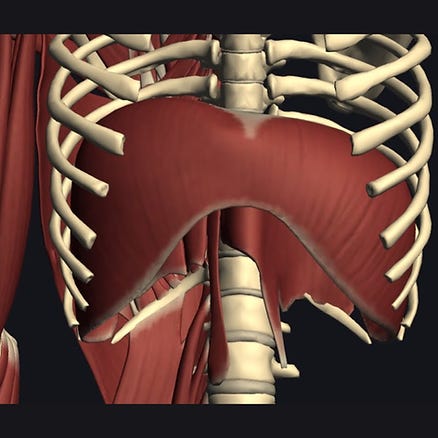
The diaphragm is a thin, dome-shaped sheet of skeletal muscle that stretches across the bottom of the rib cage.
It attaches to the lower ribs, sternum (breastbone), and lumbar vertebrae of the spine.
Its dome shape curves upward into the chest cavity when relaxed.
Inhalation : What happens when we Breathing In
When you inhale, the diaphragm contracts and moves downward, flattening out.
This downward movement increases the vertical dimension of the thoracic cavity, effectively enlarging the chest space.
At the same time, the ribs slightly lift and expand outward due to the action of other respiratory muscles (intercostal muscles).
The increase in thoracic volume causes the pressure inside the lungs (intrapulmonary pressure) to drop below atmospheric pressure.
Air flows into the lungs through the nose or mouth to equalize this pressure difference.
This process allows oxygen-rich air to fill the alveoli (tiny air sacs in the lungs) where gas exchange occurs.
Exhalation What happens when we’re Breathing Out
Exhalation is usually a passive process during normal, relaxed breathing.
The diaphragm relaxes and moves back upward into its dome shape.
This reduces the volume of the thoracic cavity, increasing the pressure inside the lungs.
Air is pushed out of the lungs as the pressure inside becomes higher than atmospheric pressure.
During forceful exhalation (like blowing out candles or during exercise), other muscles (abdominal muscles and internal intercostals) assist by pushing the diaphragm further upward and compressing the chest cavity.
Coordination with Other Respiratory Muscles
While the diaphragm is the main driver of breathing, other muscles assist:
External intercostal muscles help lift the ribs during inhalation.
Accessory muscles (like neck and shoulder muscles) engage during heavy breathing or respiratory distress.
The diaphragm’s efficient contraction-relaxation cycle is essential for smooth, rhythmic breathing.
Nervous System Control
The diaphragm is controlled by the phrenic nerve, which originates in the neck (C3-C5 spinal nerves).
This nerve sends signals that trigger diaphragm contraction automatically and continuously, even during sleep.
Voluntary control (like holding your breath or speaking) is also possible because the diaphragm is a skeletal muscle.
Gas Exchange and Life
By driving airflow in and out of the lungs, the diaphragm enables the exchange of oxygen and carbon dioxide.
Oxygen is essential for cellular metabolism, energy production, and overall organ function.
Efficient diaphragm function ensures that the body maintains proper oxygen levels and removes metabolic waste gases.
The diaphragm acts like a pump, changing the size of the chest cavity to create pressure differences that move air in and out of the lungs. Its contraction enlarges the chest for inhalation, and its relaxation allows exhalation. This continuous cycle is vital for breathing, oxygen delivery, and sustaining life.
